How Short Term Goals can create Career Success
Most people don’t fail to achieve their long-term career goals because they lack ambition.
They fail because they’re trying to plan too far ahead, with the wrong assumptions, using outdated ‘models of work’. And they find the whole idea daunting – and rarely spend time on it.
We get it. It’s like planning your finances or figuring out how to restructure your garage – it goes in the too hard / not fun quadrant.
But it really matters. Careers and the work we do are proven to be one of the most critical drivers of self-worth, identity, purpose and happiness. So lets give it a wee bit of oxygen huh?
I'm not talking about creating a five-year plan.
But a designed, adaptive system.
Why we Struggle
Sounds obvious, should be easy, doesn’t happen. Fact.
1 – I’ve proven it. The thousands of people I’ve worked with 1-1 have never worked with a coach, never had a conversation with their manager, and most are afraid to reveal to their friends and family that they are 'stuck' at work. And traditional career advice and coaches still treat careers as linear, predictable, and largely controllable.
But the reality is what most professionals are going through, looks very different:
- Roles change faster than job titles can keep up
- Skills depreciate within years, not decades
- Organisations restructure constantly
- Life events interrupt even the most “well-planned” paths
All of this – putting fuel on the fire of why we should take a strategic view of our career, before we get de-railed.
In this constantly changing, complex, and ambiguous work environment, the relationship between short-term work goals and long-term career goals needs to be rethought entirely.
2 – Research and data affirms it. In the latest Gallup State of Work Poll (2025) – it was found that 76% of people never receive a career conversation or plan from their managers.
Because the real truth is, people find it hard to navigate their careers - and managers find it even harder, to do for people. Why? Because they are fundamentally conflicted. The majority, want people to stay where they are. And imagining the chnange, progression, or worse - them leaving - doesn't feel intuitive. So they avoid it.
So if managers are not interested in helping people with progression and people find it hard - bingo - disengagement at 60% plus.
Before we talk about what works, it’s worth naming what doesn’t.
Common misconceptions about Career Planning
Misconception 1: “Long-term clarity comes first”
Many people believe they must have a clear 5-10 year destination before taking action. A bit like writing a business plan – detailed, descriptive, and - impractical. In reality, clarity and motivation – come from action. Not from hypothetical essays. The best way to plan, is to start taking action.
Misconception 2: “More planning reduces risk”
Over-planning often increases risk by locking people into assumptions that are largely guesswork, and will inevitably change. By the time you’ve written and perfected your plan, the jobs or work you are imagining – are already changing. You have to move fast, and experiment constantly.
Misconception 3: The “right” career/job exists – I just have to find it”
This creates paralysis. And is simply, a mis-truth. The reality is – we can all do many things. Which should bring you increased hope – as long as you have a good process to make decisions. Careers are shaped by data, insights, multiple ideas, and sequences of decisions - not single irreversible, risky moves.
Misconception 4: “Career coaching should give me answers”
Advice-based coaching assumes the future answer already exists - and you know it - you just have to be coached to realise it. However when planning volatile solutions, what people need is not to be pushed to look inside – at a blurry set of data that looks like a randomnized puzzle of their life – to find the answer.
No, when solving a creative, complex, ambiguous challenge – you don’t need continuous self-reflection to find answers — but better design & decision frameworks.
As Reid Hoffman famously put it:
“A career is a long-term game of improvisation.”
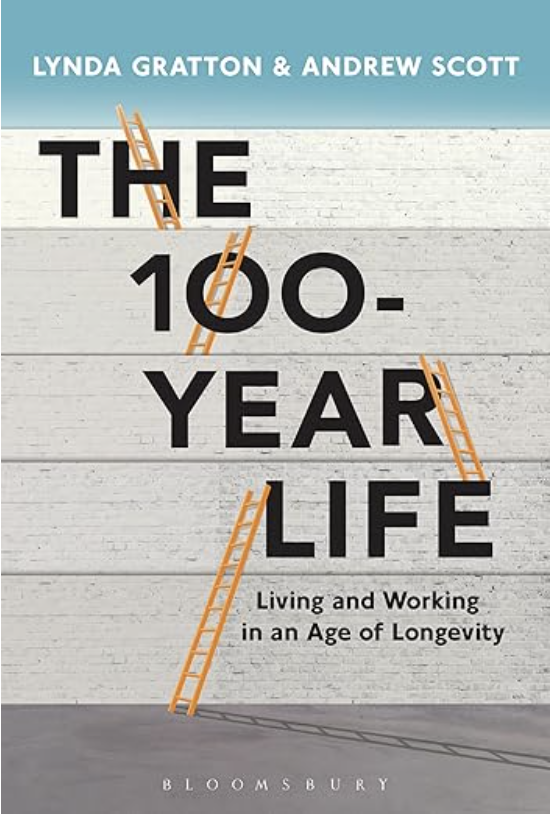
This aligns closely with what "The 100-Year Life" book states: careers are no longer single arcs, but multiple phases of reinvention across a much longer working life.
Personally? I think this is super exciting – we are living in a time when we can literally, have up to 5 careers if we want them. So lets unpack a better way to prepare for the future ahead.
The Real Problem with Traditional Career Coaching
Most career coaching models - whether inside companies designed by HR or Managers – or from hiring an actual Coach / or a Friend acting as one - still rely on static tools:
- Personality or Values tests frozen in time
- Skills inventories that age quickly
- Linear progression frameworks
- Generic “goal-setting” templates
They assume:
- The persona will broadly remain stable
- The market will be predictable
- Opportunities will be visible in advance
- Skills & Experiences today, will fit the future ahead.
Most of those assumptions are obsolete.

What people actually need is:
- A design-led process
- Continuous feedback loops
- Real-time labour & job market awareness
- Structured activity-based experimentation
- And tools that support them to evolve as they do
This is where short-term goals stop being a 'nice to have' - and start becoming the engine of long-term career success.
Reframing the Relationship Between Short and Long Term Goals
It's not a mistake to have long term aspirations. The mistake is - you're confusing vision with planning.
A useful career system separates the two.
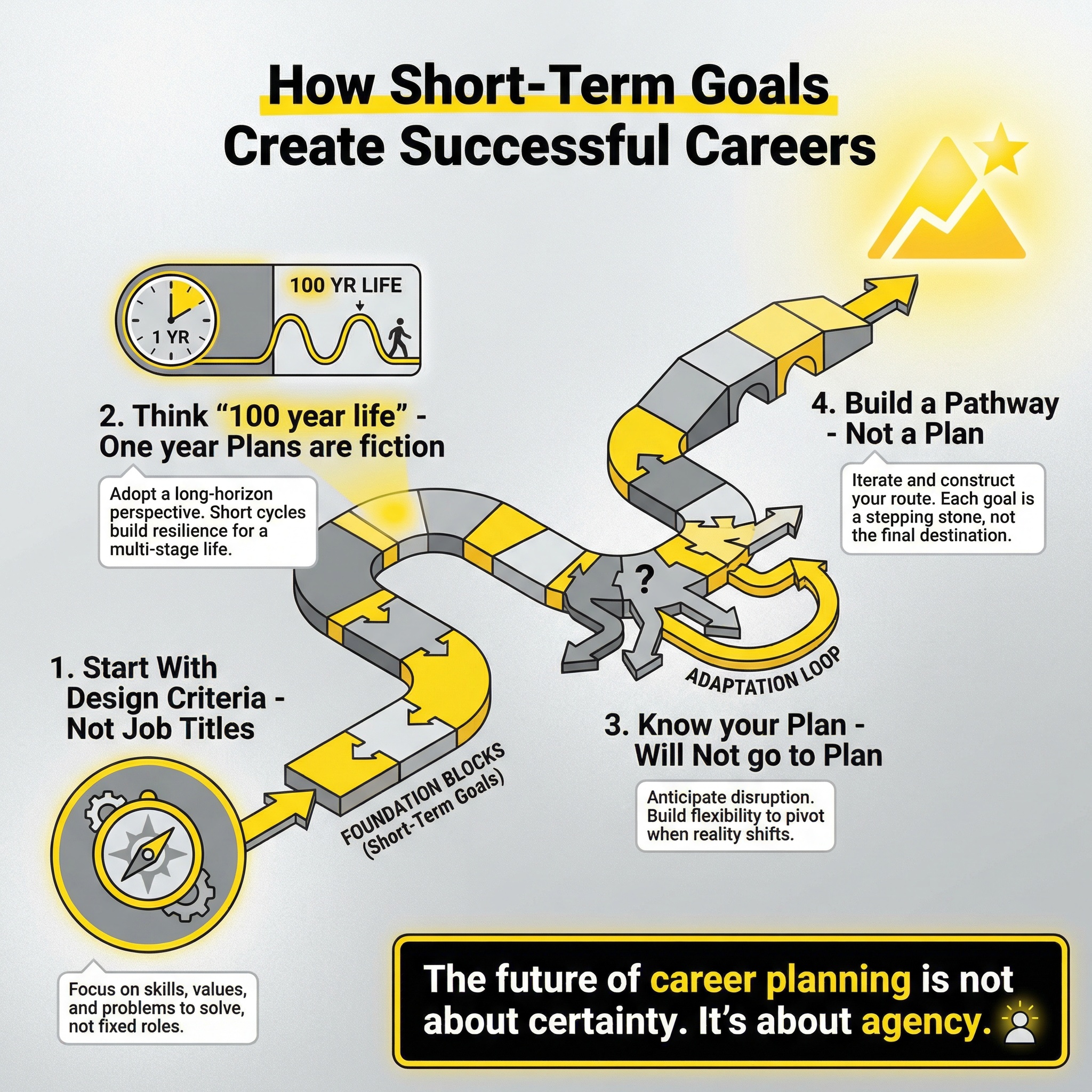
1. Start With Design Criteria - Not Job Titles
When planning a career - whether short or long term - you need to design the criteria for change. That is always the beginning of any change project, and planning in life is the same as in business.
Not defining the outcomes.
Not deciding on the job or roles you want.
But truly understanding the needs, constraints and attributes that will shape good decisions for now.
Examples of design criteria include:
- Are my values changing?
- What are my primary needs right now - security, flexibility, learning, impact?
- What is my current purpose for working?
- What have I learned are the activities that bring me 'flow' (I’m good & I’m challenged by) And what activities drain me?
- What are the industries or causes I want to make a contribution to?
- How is work optimising my lifestyle right now?
These criteria matter because they change as you grow and gain wisdom. Sometimes, they can change within months – if you’ve had a significant life event, for example.
So having a private space to capture this data and insights, adapt your plan, and review the possible options for a new career, is critical. It means you are constantly seeing the version of you, that will help you make better decisions.
Which means your career data should rarely apply beyond:
- 2-3 years, or
- Until your next meaningful reset point
This is uncomfortable for many high-performers who like to have plans set - but it’s far more realistic and successful way.
Short-term goals become valuable when they are:
- Anchored to current design criteria
- Explicitly temporary
- Reviewed, not defended
This is how short-term goals protect you from long-term misalignment, and risky painful outcomes.
2. In a 100-Year Life, One-Year Plans Are Fiction
We are now living in what many researchers describe as a “100-year life" era. This doesn’t mean long-term thinking is irrelevant - it means planning horizons have to be shorter.
You can - and should - have a long-term vision for what your“end-of-life work” or retirement looks like. It should include:
- What resources do you want?
- What experiences matter?
- How do you want to be living?
- What relationships do you want to maintain?
- What habits do you want to have built?
- What freedom or choices will be available to you that aren’t now?
But that vision is not a plan - it's an outcome.
But that vision is not a plan. It’s an Outcome.
The plan starts with one question:
“What should I do first - or next - to move meaningfully toward that vision?”
A useful framing is to think in three broad phases (not timelines) - as without building foundations first, achieving the end vision at 55 or 65 – might be very tricky:
- Create your Platform
Build deep, relevant Technical & Professional Skills, have credibility in at least one Subject area, Build broad Professional networks, have some Generalist Experience eg ‘management’ - Securing Resources
Have capital aside to enable some financial stability, have leverage from being highly valued in your ‘field’, create Options and flexibility for how and where you work, protect your Reputation and Grow your personal brand. - Scale your Impact
Be seen as an Influencer in your category, have the Autonomy to work when/where you want, Have Equity in something (don’t sell time), have Global Reach, have a Legacy Narrative that allows speaking / books / events.
Short-term goals should serve your current phase, not your imagined future self.
3. Accept That Your Plan Will Not Go to Plan
You cannot plan for:
- Economic shocks
- Health events
- Care responsibilities
- Organisational change
- Technological disruption
Trying to do so creates false confidence.
Instead, resilient career planning focuses on two things:
1. Knowing your non-negotiables
These are the elements you must protect even when you pivot:
- Income floor
- Learning needs
- Geographic constraints
- People & culture that energise you
- Boundaries for wellbeing
- Family or community commitments
2. Prototyping instead of committing
Just as in product design, careers benefit from:
- Trials
- Experiments
- Low-risk tests
- Reversible decisions
You might think a role, industry, or pathway is right - but until you experience it, you don’t really know.
Short-term goals are most powerful when they are framed as experiments, not promises. So you don’t lock yourself in too quickly to the ‘idea’ of something, before knowing if it will actually work for you.
4. Career Pathways Matter More Than Career Plans
One of the biggest blind spots in career planning today is not considering ways of working. Today, career success is no longer just about what you do - but how you do it.
Examples of work pathways include:
- Full-time employment
- Portfolio / Gig careers
- Specialist Contracting
- Fractional leadership
- Founder-led entrenprenuership
- Hybrid or seasonal work
- Academic careers
- Creator lifestyle (art, music, writing)
And for each of these - multiple jobs exist - they are just wrapped up in a different delivery package.
The right question is no longer:
“What job do I want?”
But:
“What working pathway supports my life now - and gets me closer to the life I want to build next?”
Life and work are not separate systems.
Planning a work pathway without considering:
- Energy
- Relationships
- Health
- Place
- Play
- Time autonomy
Almost always leads to burnout or regret. Short-term goals allow you to test pathways, not just roles.
Why Design-Led, AI-Enabled Career Systems Are Emerging
Career Planning as a category is being re-designed. The big change that is underway is not just about better goal-setting.
It’s about better systems.
Design-led, interactive, AI-enabled career platforms - like Actvo - are emerging because they:
- Are easily and continuously adaptable, as people change
- Surface real-time, market sourced opportunities
- Encourage experimentation over commitment
- Reduce reliance on outdated advice + content
- Reduce human bias from people with vested interest in you (managers/friends)
- Deal with emotions and fear well, with strong process and data reliance
- Support both individuals and managers
They treat careers not as static plans - but as living systems.
Short-term goals and activities devised by you and when completed become:
- Micro-moments of learning
- Inputs into skill-building
- Signals for adjustment of roles and direction
- Data for better decision making
And long-term career success becomes an emergent outcome - not a forced plan.
The Bottom Line
Short-term goals don’t undermine long-term career success.
They enable it - when designed well.
The future of career planning is not about certainty. It's about agency.
It’s about:
- Clear design criteria
- Short planning horizons
- Adaptive pathways
- Self-directed action
- Continuous feedback
- Iterating your way to a decision
- And the courage to revise the plan as you grow
In a world where work is constantly changing, the most strategic career move you can make is not committing to a destination - but building a system that helps you navigate your future intelligently, one step at a time.
If you want to start today, enrol for a free trial of Actvo now.
We bring you the system, you bring the commitment.
.avif)