The Impact of AI on Jobs and the Workforce

“We are building the machine faster than we are building the people who must operate it”
I decided to put some time into researching what’s happening in the workforce in relation to AI – given the work we do here at Actvo.
And there were some revealing insights and startling truths.
Many you may know - some might be adjusted by this more recent information.
My starting point was that the public conversation about AI and jobs is very polarised.
On one side: talk of ‘mass unemployment, creative destruction, and wide spread fear’.
On the other: ‘productivity miracles, infinite leverage, and “everyone will be fine.”’
Where do you sit?
The reality is obviously much more complex, and I would argue more urgent.
The most credible research published since 2025 points to historic job churn, not job extinction.
Some roles will disappear.
Many more will be redesigned.
Careers aren't necessarily changing.
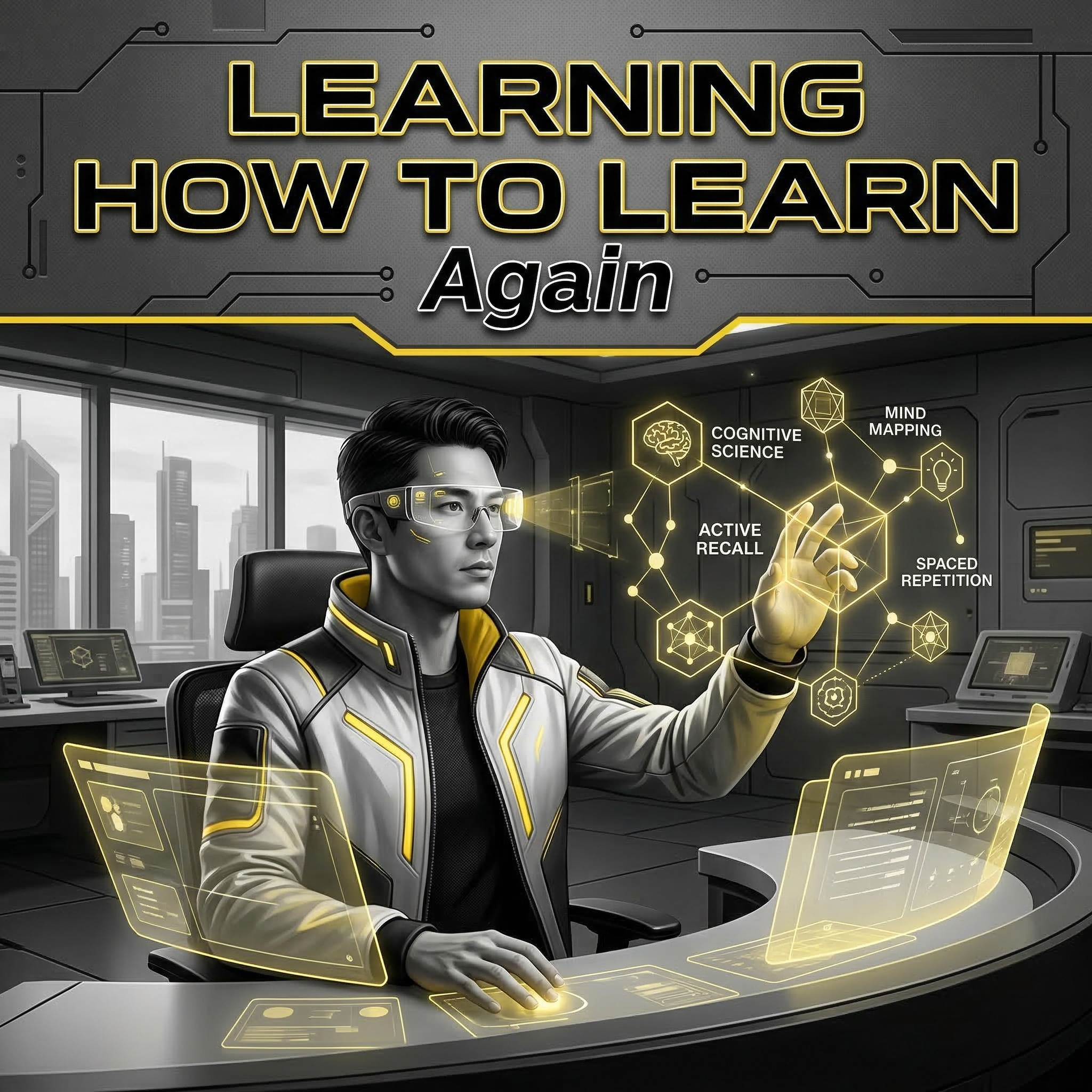
Up-skilling and self-directed skill development is the antedote.
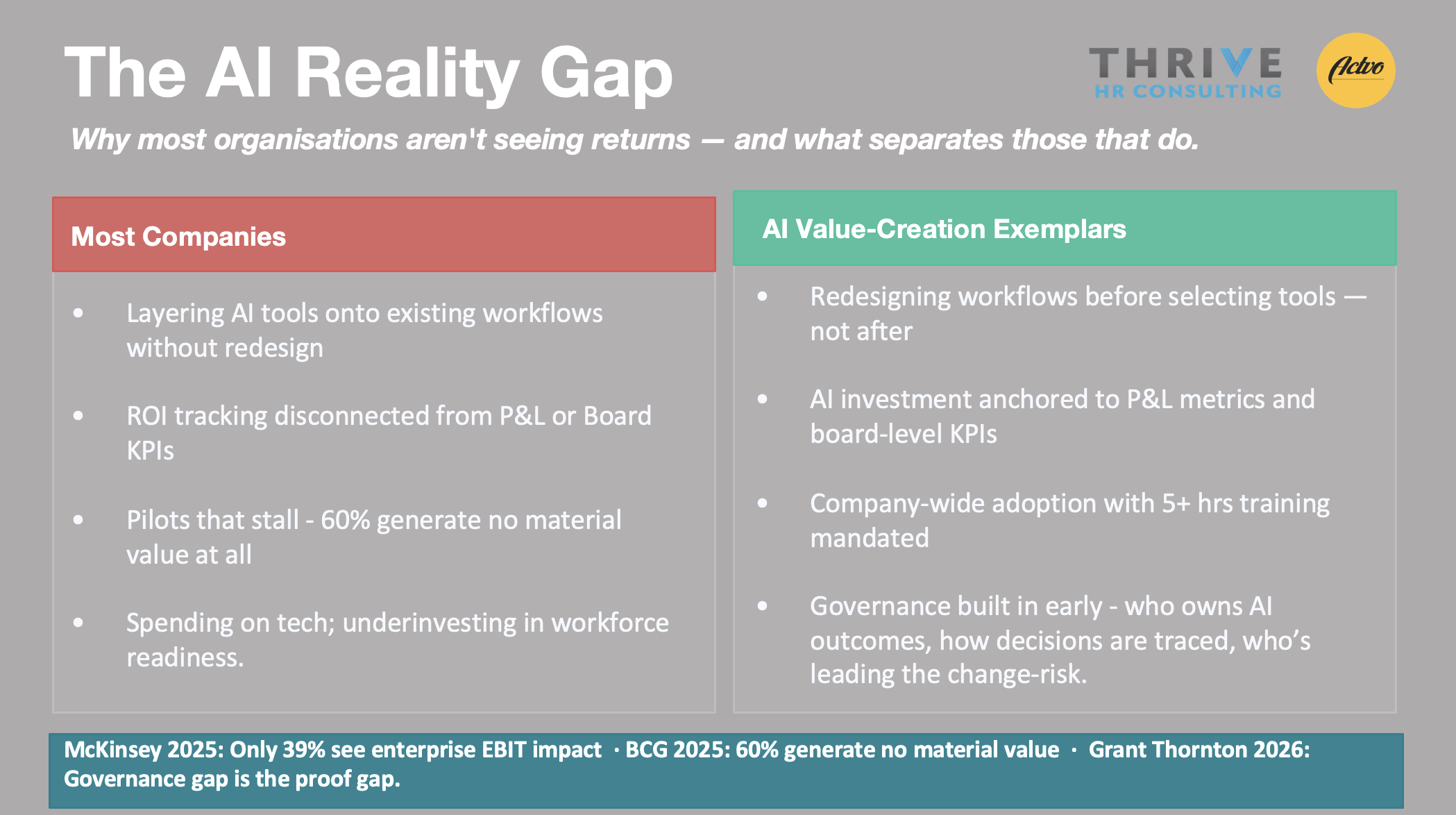
And the largest risk overall to businesses? Is not the automation itself, but the gap between how fast AI is being deployed and how slowly people are being supported to adapt.
Lets dig deeper.
What the Experts are Actually Predicting (2025+)
I got my GPT to help with pulling some recent research on what the main experts are predicting. Here’s what I found.
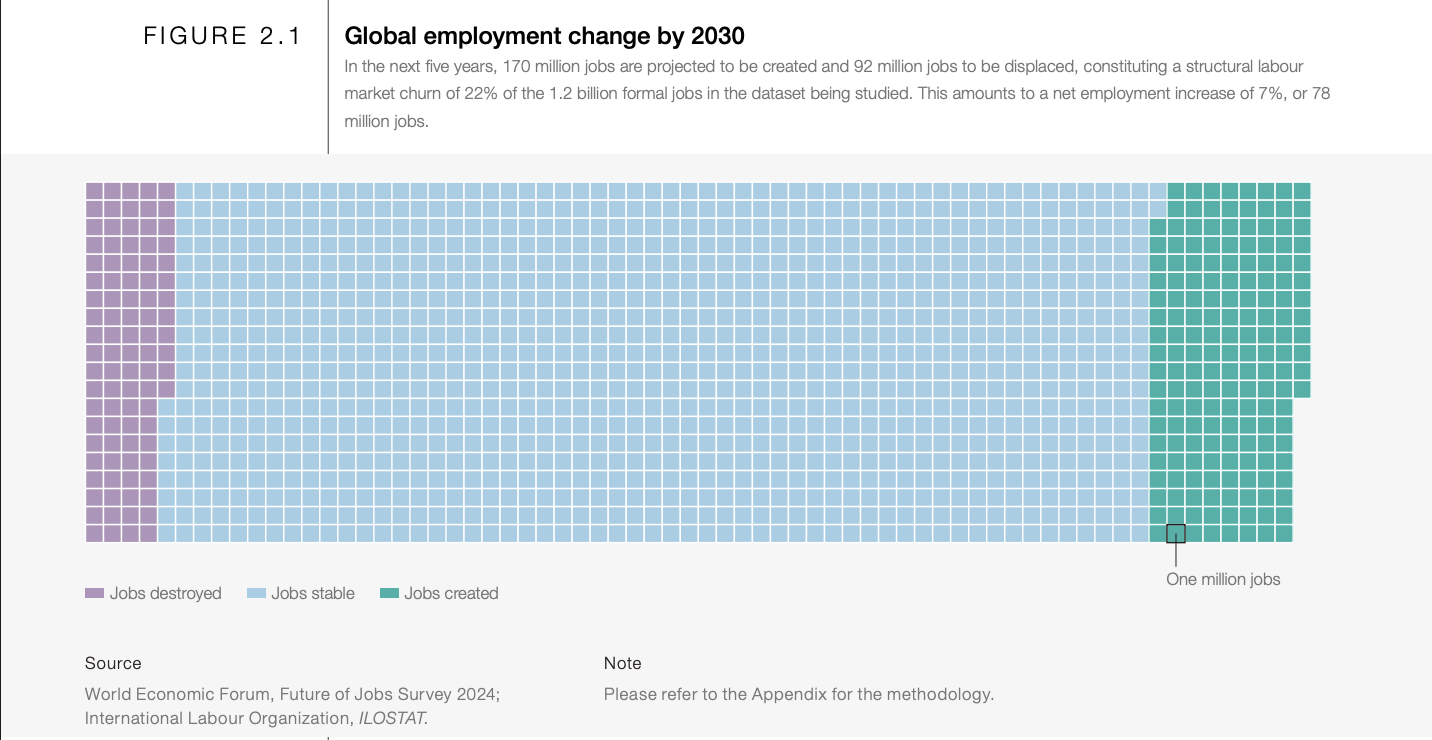
Jobs Displaced or Eliminated by 2030-
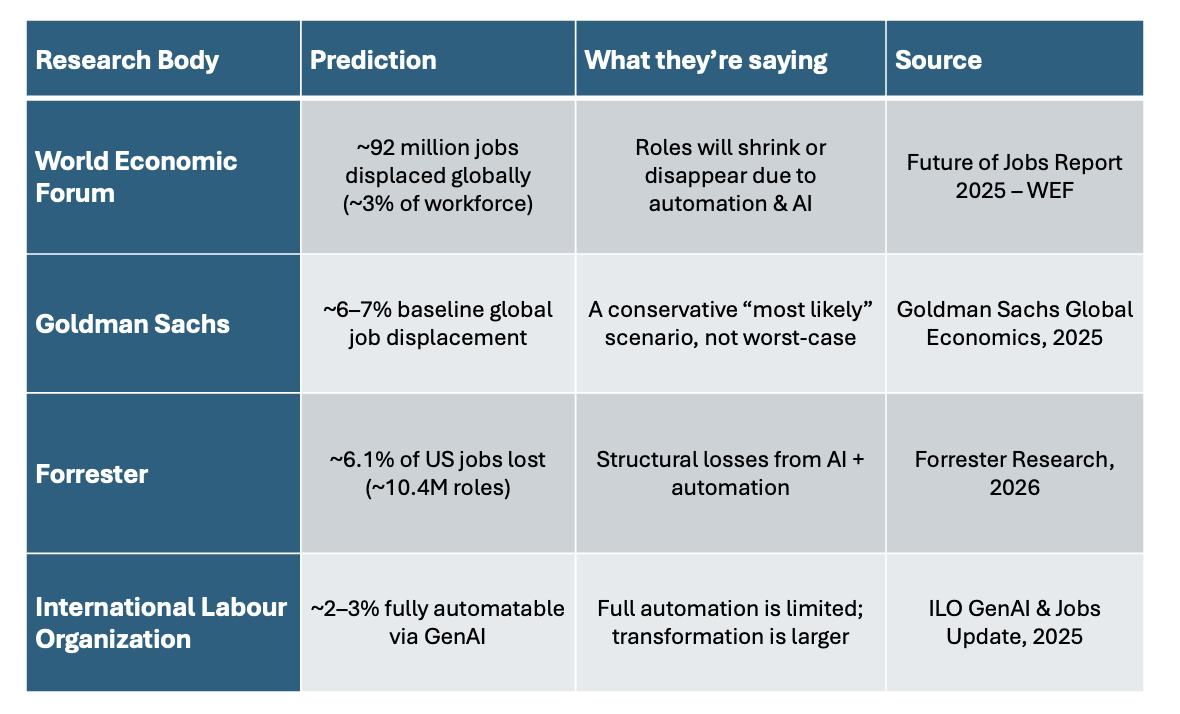
The Key Signal? Credible institutions are converging around low single-digit job elimination of jobs – not double-digit collapse. The game here isn't about mass churn, its about massive need for a focus on transferable skills.
Jobs Adapted, Augmented or Redesigned by 2030:
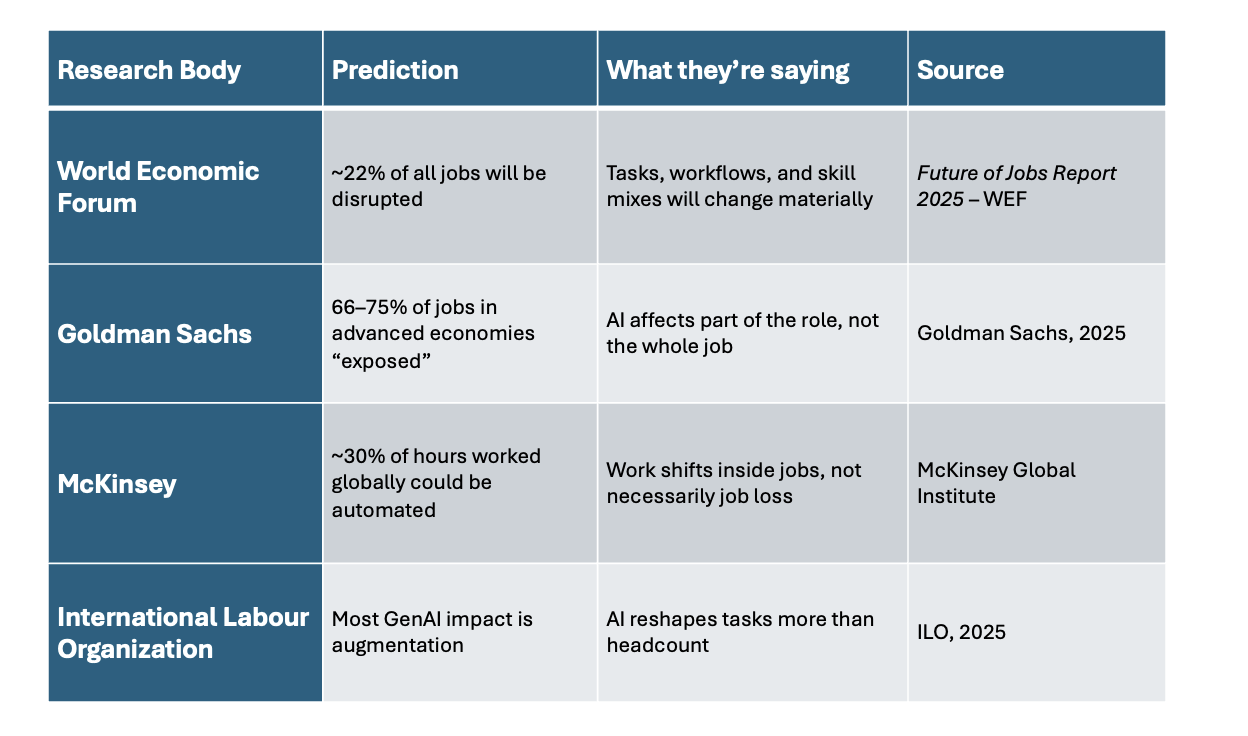
The key signal? The dominant impact of AI is not job loss - it's job redesign at scale. It's about new skill development and career adaptation.
With a global workforce of~3.4 billion people, even with a “modest” 20–25% redesign means 700–850 million people will probably need to change how they work within the next five years.
That is the real transformation underway. And that’s epic – we are truly living in a phenomenal industrial-technical revolution
The Overlooked Middle: Knowledge Workers must Adapt Now
When we move onto who will be most impacted, public debate tends to fixate on two extremes:
- Roles that are clearly able to be automated
- Roles that feel “safe” because they involve ‘judgment or creativity’
What gets missed is the middle segment, which is also the largest. Roles that will be adapted.
This includes:
- Managers and team leaders
- Analysts, engineers, designers, marketers, finance professionals
- Policy, compliance, HR, operations, and product roles
These jobs are not disappearing overall - but they are being re-shaped at speed.
Recent research consistently shows:
- Knowledge work is highly exposed already to GenAI
- Exposure does not equal replacement
- Productivity gains accrue fastest where humans learn to work with AI
As Business Insider summarised in recent cross-industry analysis in 2025:
“Clerical work is most likely to be automated. Higher-skill roles are far more likely to be augmented.”

This middle segment likely represents 30–40% of the global workforce - hundreds of millions of people who must adapt their workflows, self-direct their learning, do some fast decision-making about career change or skills development.
The risk is not redundancy.
The risk is falling behind inside your existing role.
How Leading Companies are Preparing
No doubt you are already considering how to adapt your workforce. Although, I am yet to meet on an everyday basis people who can describe to me the experiments they are running and the effectiveness they are testing.
The most effective organisations are now moving beyond “AI pilots”, toward actively making operating-model changes. We all have to start stepping into the arena - preparing ourselves as Leaders/Managers so we can then prepare our people.
1. Redesigning Workflows, not just Deploying Tools
Companies like Unilever andJPMorgan Chase have publicly discussed embedding AI into core workflows(marketing, legal review, risk analysis) rather than experimenting at the edges.
Boston Consulting Group’s 2025 research shows organisations that redesign workflows see 2–3× higher productivity impact than those running isolated use cases.
2. Treating AI Governance as a Business Discipline
Firms such as Microsoft and Salesforce have long established internal AI councils spanning legal, HR, security, and operations - not to slow adoption, but to scale it safely.
Governance is no longer about gaining the Lead Teams “permission.” It’s about generating trust, accountability, and consistency into the way AI is being used in the organisation.
3. Moving from Generic Training to Role-Based Capability building
Leading organisations are abandoning “AI literacy courses” in favour of role-specific "Adaptive Enablement"
- How does AI change this manager’s job?
- This analyst’s workflow?
- This customer interaction?
This shift reflects a broader truth: people need to just learn tools - they need permission to learn how to perform better with tools, in the context of their specific job/role. And the focus has shifted from generic training, to self-directed learning.
The Money Imbalance: Machines vs People
This is where the story becomes a bit darker. I listened to a fascinating PodCast this morning called “AI and the Future of Work” by the Centre for Humane Technology. Which got me really interested in this topic:
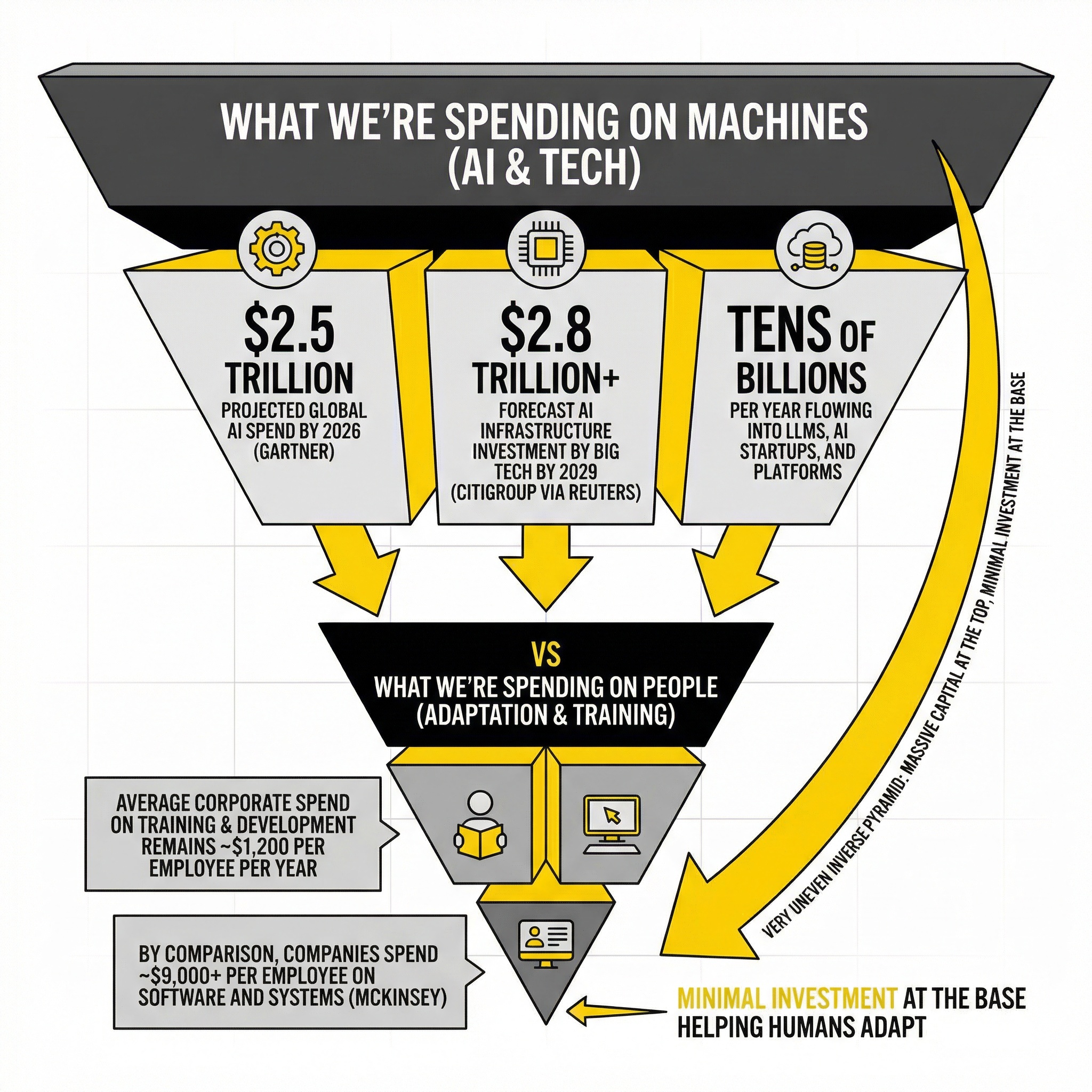
What we’re spending on machines -
- $2.5 trillion projected global AI spend by 2026 (Gartner)
- $2.8 trillion+ forecast AI infrastructure investment by Big Tech by 2029 (Citigroup via Reuters)
- Tens of billions per year flowing into LLMs, AI startups, and platforms
What we’re spending on people
- Average corporate spend on training & development remains ~$1,200 per employee per year
- By comparison, companies spend ~$9,000+ per employee on software and systems (McKinsey)
Visually, this is remarkably bad. It’s a very uneven inverse pyramid of:
- Massive capital at the top building systems
- Minimal investment at the base helping humans adapt
This validates my core claim:
We are building the machine faster than we are building the people who must operate it.
The Business Risks of not Correcting this
If organisations don’t start investing in adaptation now, the risks are predictable:
- Declining productivity will occur, in spite of AI project spend
- From rising fear, resistance, and disengagement
- Mass loss of institutional knowledge & experience, through preventable attrition
- Managers more overwhelmed by change they’re not equipped to lead
AI does not fail in isolation. And can’t be blamed for the impending impact.
It fails inside cultural systems designed to protect people - that aren’t ready.
Three Tactics Leaders can easily Deploy Now
Here are three actions or ideas I’ve come up with that might help you start to incrementally move forward with addressing these issues – if you haven’t found a way to start yet.
1. Redesign a Small Number of Critical Workflows
Start with 2–3 workflows that matter most (revenue, cost, risk) that you must protect from disruption.
Redesign them end-to-end with AI in mind. With the people involved.
Measure time to adapt, quality of output, and spend vs outcome (ROI) and impact - not just usage.
This anchors AI in performance and implementation reality, not just loose experimentation.
2. Update Role Expectations before you Train People
Instead of creating parallel “AI-augmented roles,” update existing role profiles
- What should AI now handle?
- What judgment or processes must stay human?
- What new skills are required?
- Can people adapt easily – what do they need?
This becomes a manager-led conversation, supported by HR, before any training begins.
Clarity first. Learning second. Capability outputs later.
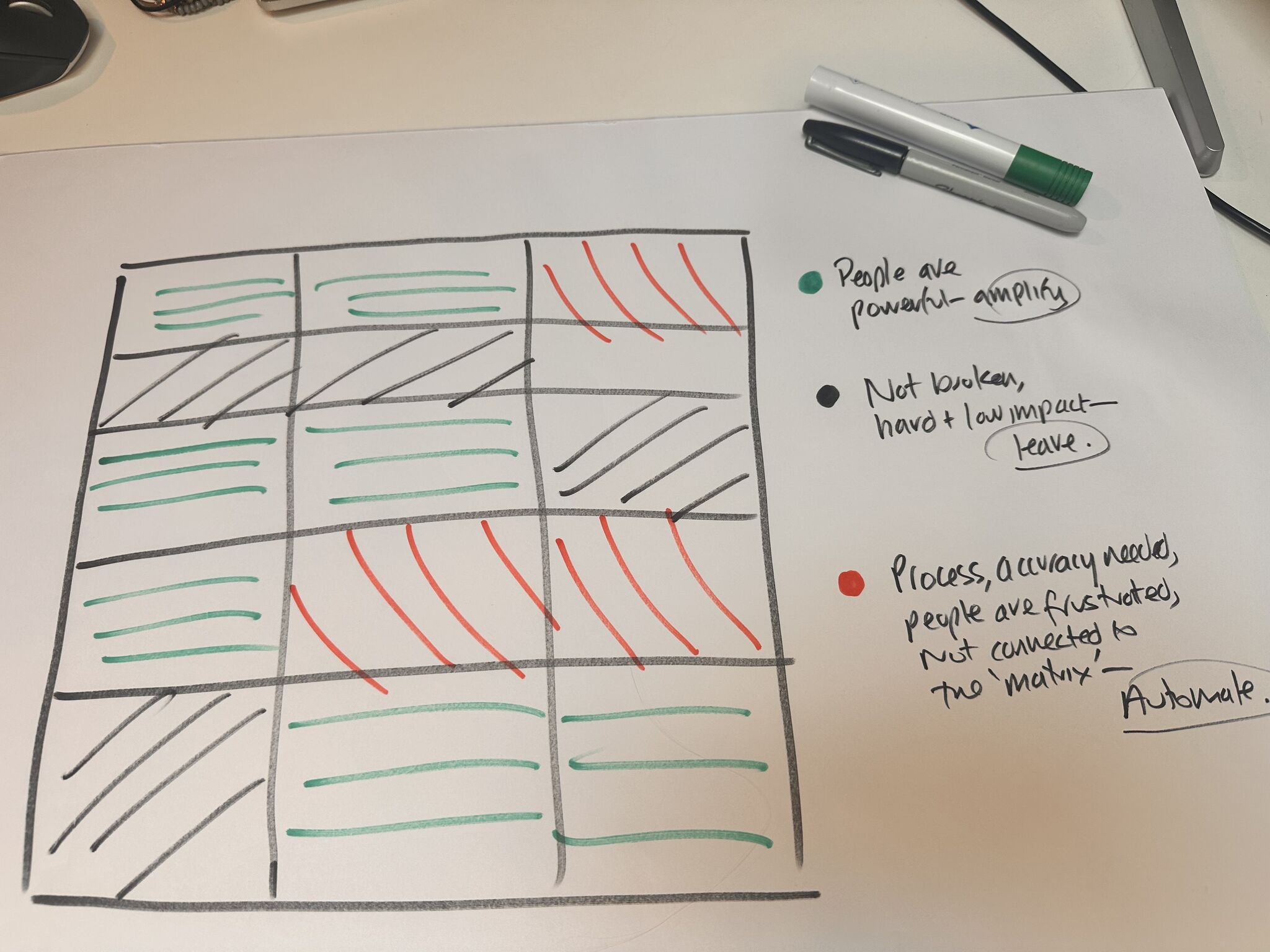
3. Create Internal Project Teams for on-the-job Learning
Allow employees to opt into short, real AI-enabled projects alongside their current role.
This builds skills before people have to change jobs - and often removes the need to change roles at all. Creating an agile workforce of people who are motivated to work with AI –give the early adopters agency and pathways to move forward.
Together, these types of ideas if implemented well should:
- Reduce fear
- Accelerate self-directed learning
- Preserve talent
- Turn adaptation into a continuous process
In Closing
AI is not here to take our jobs, nor will it simply change jobs.
It will change the contract between organisations and their people.
In a world where work is continuously being redesigned, the organisations that win will be those that make adaptation safe, visible, and supported - not those that automate fastest.
I hope in this article I have convinced you that the future of work is not about choosing people or machines.
It is about whether we are willing to invest in both - at the same pace.
If you are, lets discuss how Actvo can support you and your team in creating the change contract – what do people want to do with their careers+AI and how will they achieve it.
.avif)