AI is transforming workforces. Fact.

AI Is Transforming Workforces. Fact.
But most organisations still haven’t designed for "Human Adaptation".
Over the past 12 months, I’ve had more than 100 conversations with businesses across New Zealand and the United States about AI, workforce change, and the future of work.
Some were with CEOs trying to understand where to invest.
Some were with HR leaders worried about capability gaps.
Some were with managers quietly trying to work out what AI means for their teams - and whether people are ready for what’s coming.
More recently, Actvo partnered with Thrive HR Consulting in Denver to host a webinar with leaders from more than 15 organisations across NZ and the USA exploring one central question:
How should organisations actually adapt their workforce to AI?
And what became very clear very quickly was this:
Most organisations are now actively deploying AI.
But very few have yet designed a real strategy for helping humans adapt alongside it.
I believe that distinction may become one of the biggest competitive differences of the next decade.
Nobody Is waiting anymore
At the start of the webinar, we asked attendees where their organisations currently sat on the AI journey.
The results were revealing.
Current AI Position:
46% - Allowing experimentation, but not yet systemised
23% - Implementing automation company-wide
23% - Actively adapting teams & roles to use AI
8% - Researching and running pilots
0% - Thinking about AI but doing nothing0%
The “wait and see” phase is over.
Organisations are moving.
Budgets are appearing.
Technology adoption is accelerating faster than almost any previous workplace technology shift any of us have seen in our lifetime.
According to the Stanford AI Index 2026, Generative AI adoption has scaled more than twice as fast as the internet itself.
And global AI infrastructure spending is expected to exceed US$318 billion in 2026.
But despite the scale of investment, the returns remain mixed.
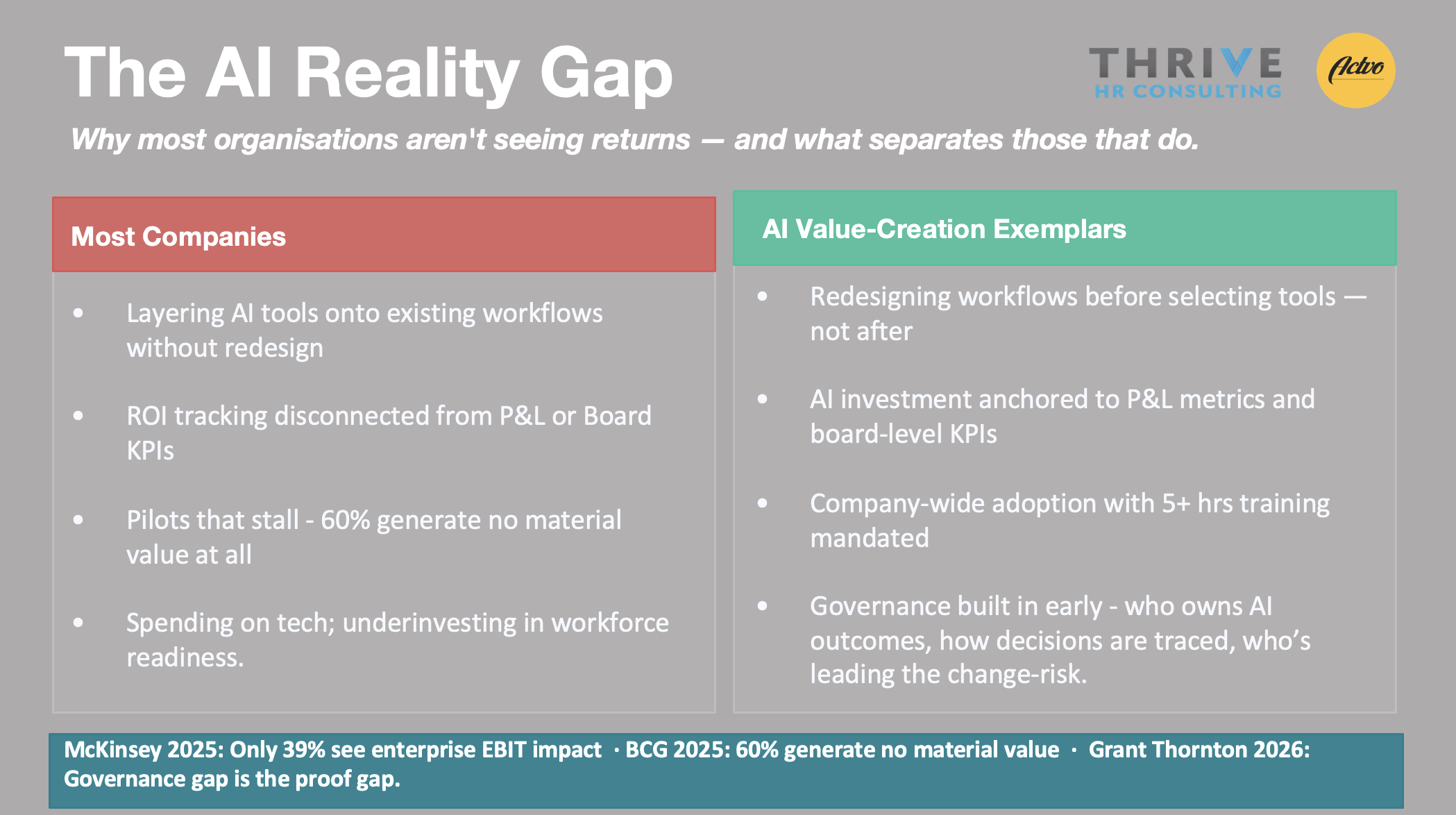
McKinsey’s 2025 State of AI research found that only 39% of organisations report measurable enterprise-level EBIT impact from AI so far.
Why?
Because deploying technology is not the same thing as re-designing work. It's only a part of the picture - its the 'quick fix' - not transformation, yet.
The Three Workforce Strategies emerging
In the webinar, we shared a framework emerging from both global research and our own field observations.
Most organisations are currently approaching AI transformation through one of three broad strategies:
1. Automate
Using AI to remove friction from existing workflows.
This is the “efficiency play”:
- repetitive tasks
- reporting
- scheduling
- administration
- process automation
- workflow acceleration
This is where most organisations begin because:
- ROI is visible quickly
- disruption is lower
- the business case is easier to prove
And honestly - this makes sense.
Automation is often the fastest path to measurable gains. So why not start here?
2. Augment
Is about using AI alongside humans to improve mid-term capability and productivity.
This is where organisations begin redesigning roles and workflows around AI-assisted work.
Examples include:
- AI copilots
- AI-assisted analysis
- AI-supported customer service
- Learning and coaching systems
- Role redesign
- Workforce upskilling
This is where AI starts becoming less of an IT initiative… and more of a workforce strategy. Owned and funded, by people leaders.
And interestingly, when webinar participants were asked in a poll which strategic path they believed organisations should prioritise, the largest group selected this option:
Strategic Direction you prefer:
Augment - 45%
Adapt - 36%
Automate - 18%
Leaders instinctively understand this is not just about replacing people. They know workforce capability matters.
But in practice, most implementation activity is still heavily weighted toward automation.
3. Adapt
Rebuilding the organisation around AI-enabled ways of working. Essentially - becoming an AI company.
This is the hardest path.
And potentially the most transformative.
This is not about adding tools onto existing workflows.
It’s about rethinking:
- Business models
- Operating structures
- Leadership
- Capability ystems
- Human + AI collaboration
- Workforce composition
- Competitive positioning
This is where AI stops being a productivity tool...and becomes organisational redesign. Or restart.
The Reality Gap
One of the strongest patterns emerging from both the research and our own client work is what I’d call the AI Reality Gap.
Many organisations are currently:
- Layering AI tools onto existing workflows (quick fixes)
- Running pilots without redesign (ticking boxes)
- Measuring productivity in isolation (selfish gain)
- Investing heavily in infrastructure (tech reliance on leading)
- Under-investing in workforce readiness (hard before, near impossible to do now)
But the organisations seeing stronger outcomes are doing something very different.
They are:
- Redesigning workflows before selecting tools (people-first)
- Linking AI investment to board-level KPIs ('what get measured, gets managed')
- Investing in training and capability (taking their people on the journey)
- Building governance structures early (belt and braces)
- Assigning ownership for AI outcomes (leadership)
- Actively redesigning roles and decision-making (organixational agility & future-proofing)
In other words:
The companies creating the most value are not simply deploying AI faster. They are redesigning the organisation around it more intentionally.
The Missing Investment: "'Human Adaptation"
This is the part I think many organisations are still underestimating. Honestly - I've asked sooo many companies, and no-one yet, has a really good answer thats proven.
Across conversations with:
- Business leaders
- HR consultancies
- Recruiters
- Transformation advisors
- and Companies onboarding into Actvo
…the dominant focus is still overwhelmingly: “How do we improve productivity?”
I am hearing far less conversation about:
- Workforce transition
- Human capability redesign
- Career mobility
- Learning systems
- Adaptation pathways
- Psychological readiness
- Changing identity at work
- Helping people reposition themselves economically & psychologically.
And yet the global research is increasingly clear:
The biggest barrier to AI integration is not the technology.
It is people readiness.
Deloitte, Gartner, BCG, McKinsey and Forrester are all now converging around similar findings:
- AI skills gaps are becoming the #1 implementation barrier
- most organisations still lack structured workforce adaptation systems
- AI investment is significantly outpacing investment in people capability
- many managers are unprepared to lead AI-enabled workforce change
One statistic in particular stood out to me during our research:
Only 23% of organisations offered prompt engineering or AI workflow training in 2025.
That’s extraordinary when you consider how rapidly AI tools are entering daily work. I think the assumption os "people are going to re-train themselves". Tell me - has this ever happened in the past ? Why would it happen now?
So if the current assumption inside many organisations still seems to be:
“People will figure it out.”
We need to rapidly realise - that adaptation is not automatic. It is ALWAYS designed.
We are building the machine faster than we are building the people
Historically, every major technological revolution has created two simultaneous challenges:
- Technological deployment
- Human transition
This is actually not new. The Industrial Revolution transformed production. The Internet/Dot.com Revolution transformed distribution and access to information.
But education systems, leadership models, and organisational structures adapted much more slowly.
AI may compress that transition even further.
Because unlike previous technologies, AI is not just changing tools.
It is changing how we think.
How we make decisions.
How we learn.
How we will manage people.
How careers will be structured, and increasingly -
How economic value is going to be earned and measured.
And yet many organisations are still approaching it primarily as a software deployment exercise.
The real competitive advantage won't be AI
Eventually everyone will have AI tools. We will all be working with automated workflows, and deploying agents and co-pilots. Everyones baseline productivty will change. That - very soon - won't even be new.
Those advantages will commoditise.
The more enduring advantage I believe will become something much more difficult to master. Because we have always struggled with it.
Organisational Adaptability.
The ability to continuously help humans:
- learn
- reposition
- evolve
- redesign their work
- build new capability
- integrate technology / AI meaningfully
- and navigate ongoing change.
I geniuinely believe - this is what will set apart organizations that win the AI race, from those that just adopt it.
They will be the organisations best able to help humans adapt alongside it.
The question leaders need to ask now?
The real question may no longer be: “What AI tools should we deploy?”
But instead: “What kind of workforce are we becoming?”
Because AI transformation is no longer just a technology conversation.
It is now a leadership, a governance and a capability conversation. And ultimately - a human transformation conversation. We all need to be having at the top table inside our companies.
And the organisations that understand that the fastest, I think will create the deepest long-term advantage.
.avif)