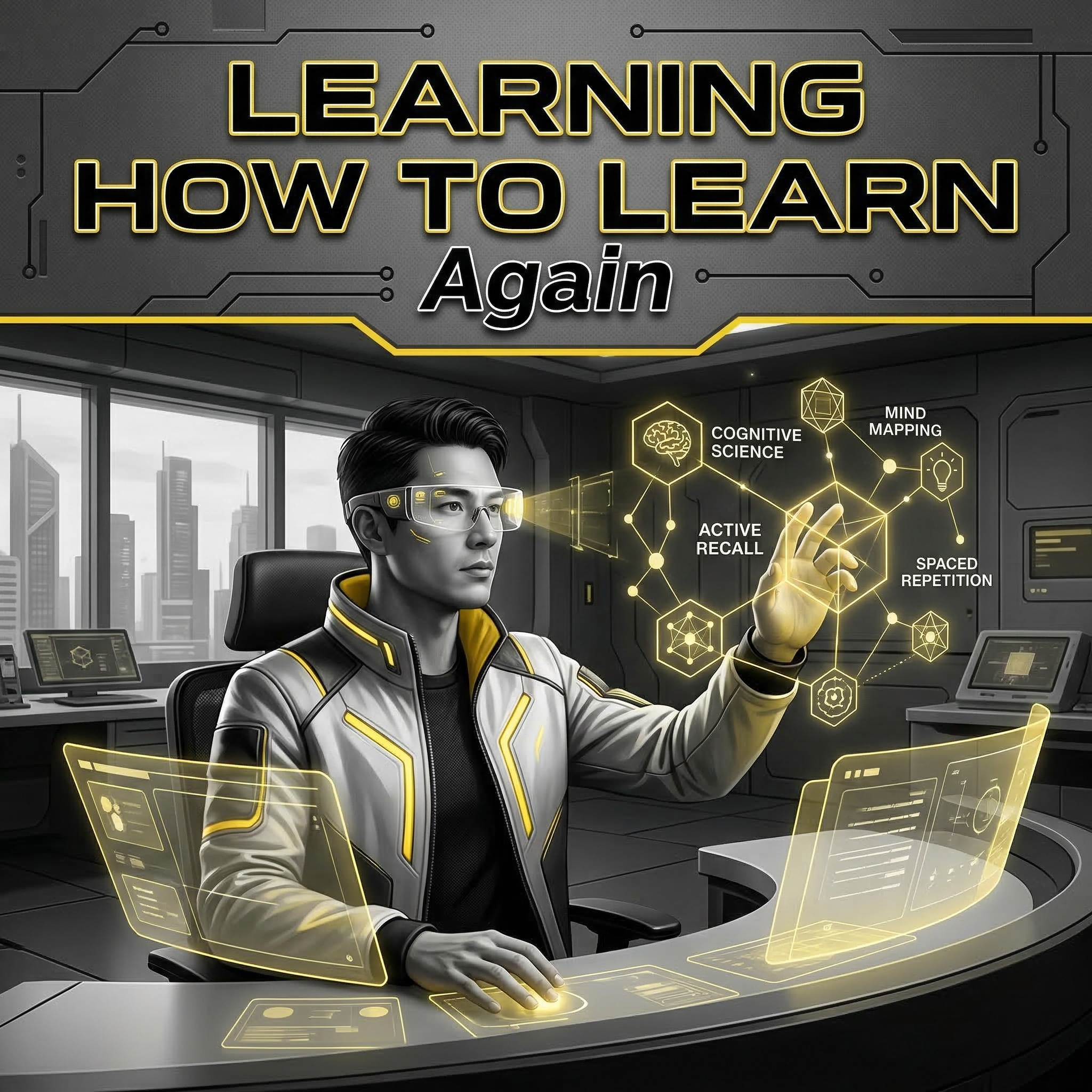
Learning how to learn again - the SuperSkill of our Age.

Learning & Development -
Why we need to Learn how to Learn Again.
When did learning stop being part of the job?
I'm not talking about compliance training.
Or ticking off a course once a year.
Not even the occasional workshop your manager sends you to.
Real learning.
The kind that changes how you think, how you work, and what you’re capable of next.
Because here’s the reality:
For knowledge workers today, the job is learning.
And yet - most organisations haven’t caught up to that.
What do we actually mean by "Learning" and "Development"?
Before we go further, it’s worth separating two ideas that often get blurred together. Particularly when thinking about Corporate Learning & Development programmes or strategies.
Learning is about gaining new knowledge or skills.
It’s the input. The exposure. The understanding.
Development is about applying that learning over time to grow capability.
It’s the output. How your behaviour changes. The progression that follows.
You can learn without developing.
(We’ve all done courses we never used.)
But you can’t develop without learning.
In modern work, both need to be continuous - not occasional.
Learning & Development programs and tools are not just adapting - they are being completely remodelled to meet emerging, urgent needs.
Why Learning & Development matters more than ever
For most of the last 50 years, jobs were relatively stable.
You learned a profession.
You built experience.
You progressed within a known pathway.
That model is pretty much breaking. And fast.
- Skills are changing faster than roles
- The World Economic Forum estimates that 44% of core skills will change by 2027 - meaning nearly half of what people rely on today won’t be enough within a few years.
- Technology is reshaping entire functions
- The IMF is predicting est 40% of global jobs are exposed to AI and up to 60% in advanced economies like the US
- Career paths are no longer linear
- The average person now changes jobs around 12 times in their career -and increasingly, those moves are across functions and industries, not up a single ladder.”
For knowledge workers, this means one thing:
👉 Your ability to learn is now more important than what you probably realise.
For businesses, it’s equally critical:
- Performance depends on how quickly teams can adapt
- Retention depends on whether people feel they are growing
- Leadership depends on building capability, not just managing output
Learning & Development(L&D) is no longer a “nice to have.”
It’s critical infrastructure. And its currently undergoing a big renovation.
How L&D has traditionally been delivered.
Most organisations still operate with an older model of L&D:
- Top-down training programs
- Annual learning plans
- Compliance-heavy content
- Centralised HR ownership
Typically, this looks like:
- Mandatory compliance modules, traditionally run as courses
- Occasional leadership programs, mainly for senior leaders
- External courses for selected employees, mainly associated with performance.
- Limited follow-up or application, low links to ‘what I’m learning’ and ‘how I’m developing the expertise’ at work.
This model worked when:
- Roles were stable
- Skills changed slowly
- Career paths were predictable
But it struggles in today’s environment.
Because it assumes:
👉 The organisation knows what you need to learn, and when. And they are the best people to direct yourl earning.
That’s no longer true.
What's breaking in today's L&D models
Across businesses, a consistent set of issues is emerging:
1. Learning is disconnected from real work
Courses are completed… but not applied.
There’s no clear link to current challenges or future roles.
2. Managers don’t have time
Managers are expected to develop people - but are already overloaded.
Career conversations get deprioritised, aligned only to performance issues –not growth.
3. Budgets exist, but aren’t used
Many companies offer learning budgets - but employees don’t know how to use them effectively, and sothe benefit rarely gets realised. Notfor a lack of wanting to learn – but a lack of direction.
4. Over-focus on compliance
A large portion of L&D is still driven by risk, not growth. In fact L&D is seen as an ‘input’ to static performance – not a ‘system’ that can predict and enable future development.
5. Gen Z expectations are different
Newer employees expect:
- Personalised growth
- Faster progression
- Ownership over their learning models
- AI in Learning & Development - to create personalised plans and creative options
They are far less willing to “wait their turn.”
6. Technical skill gaps are growing
Despite increased demand
- Fewer employees are engaging in deep technical training
- Many don’t know what to learn next
The Shift emerigng - new modes of Learning
We’re starting to see are new L&D ecosystems forming - and they look very different. Learning & Development Managers roles are being changed, with the shift moving to moreenabliment of learning systems, than prescribing learning content.
1. Technical Training is Becoming Immersive and AI-Driven
Technical learning is evolving quickly through:
- AI-powered tutors and assistants
- Adaptive learning platforms
- Virtual and augmented reality simulations
Instead of static courses,learning is becoming:
👉 Interactive, personalised, and continuous
Employees can now:
- Practice skills in real-time environments
- Get instant feedback
- Learn at their own pace
2. The Rise of On-the-Job Learning
Some of the most effective learning isn’t happening in courses at all.
It’s happening through:
- Shadowing experienced colleagues
- Mentorship and coaching
- Stretch assignments
- Project-based learning, by experience.
This model works because:
👉 Learning is embedded in real work, not separate from it
It’s faster, more relevant,and more likely to stick.
3. LXP Platforms & Career NavigationSystems
A newer category is emerging - platforms designed to help individuals:
- Understand themselves
- Identify skill gaps
- Explore career pathways
- Build personalised learning journeys
This is where systems likeActvo sit. Actvo® is the world’s first navigation system for self-directed careers – designed for individuals. Joining a growing category that also offer enterprise wide solutions.
Instead of pushing content, these platforms:
👉 Enable self-directed learning
They help individuals answer:
- What am I good at?
- What do I want to do next?
- What skills or experiences do I need to get there?
- How do I learn them in a way that fits my work?
This shift is critical - because careers are no longer managed for people.
They are navigated by people.
Why Adults struggle to Learn at work
If learning is so important- why do so many people stop doing it?
There are a few common reasons:
1. Time pressure
Work feels urgent. Learning feels optional.
2. Lack of clarity
People don’t know what they should learn next. Or how to source it.
3. Fear of starting again
Learning something new can feel uncomfortable - especially later in your career. It needs to link to some growth goals.
4. No immediate reward
Unlike completing tasks,learning doesn’t always deliver instant results. It needs to be part of a pathway towards some greater opportunity, to create intrinsic motivation.
5. Poor past experiences
Many people associatel earning with:
- School
- Exams
- Irrelevant content
And it can often trigger memories associated with failure or effort. So they disengage.
How we can start learning again
If you’re feeling stuck - the goal shouldn't be to “do more courses.”
It’s to rebuild your learning habit. Here’s where to start:
1. Start with direction, not content
Before learning anything, ask:
- What am I trying to move towards?
- What problem am I trying to solve?
- What would I most like to change in my life/work?
2. Learn in small, consistent blocks
- Select a single challenge to work on - define it clearly - whats the shit you want to achieve.
- Apply 15-30 minutes every day -r at least twice a week - to work on it in a focussed way.
- Learn your way - if that's observing others, great. If its’ listening to podcasts, also good. Figure out your learning needs andchoose resources that match.
3. Apply the learnings immediately
Don’t wait for your manager or organisation to ‘ask you’ to use the learning. Start applying it immediately - use what you learn in your current role as quickly as possible, to embed it and make it partof your intrinsic skill-set.
4. Mix formats
Explore and experiment with your learning style. Depending on WHATyou want to learn, you might try a different HOW you learn. Combine:
- Reading
- Watching
- Doing or Making
- Talking with others
- Experimenting & validating.
5. Track what you’re building
Not just what you’ve completed - but what you can now do. Skills are the key to growth in the future – map what skills you’ve gained, and what capability that allows you to bring to the organisation as aresult.
How Team Managers can better support Learning
Managers play a critical role - even if they don’t have much time.
Here are simple, high-impact actions:
1. Allocate time, not just budget
Learning doesn’t happen without space. If you want to embed learning into the business, make time for it – authorise it.
2. Make it relevant
Connect learning to:
- Current work
- Future opportunities
Ensure what people are learning has a clear pathway for improvement for them, and the organisation bycompleting it – growing motivation.
3. Encourage ownership
Don’t prescribe everything. Help individuals design their own pathways. And be open to learning from them, what their purpose it.
This is great insight as to their aspirationsand hidden goals.
4. Follow up
Ask:
- What did you learn?
- How are you using it?
- How has it changed how you work?
- What does this enable for you – and us?
5. Provide access to the right tools
Not all platforms areequal.
Choose ones that support:
- Personalisation
- Skill Building – distinctive to Career planning
- Career navigation – that’s discovery based, not prescriptive. Enabling you to influence future options with them.
- Practical application activities – not just courses
- Planning & accountability tools – to make it easier for employees to integrate with their work.
Final Thought - Learning, is the job now.
We need to rethink how we see Learning & Development.
It’s not:
- A compliance requirement
- An HR initiative
- A once-a-year activity
It’s:
👉 A core part of how work gets done
Because the reality is simple:
- Roles will change, soon
- Skills will evolve, quickly
- Expectations will rise – towards a very different structure in the near future.
The people who stay relevant won’t be the ones who know the most today.
They’ll be the ones who know how to learn, what’s next. And keep learning.
You just never know where it could take you.
.avif)