What is Career Coaching? And how is it changing in the Age of AI.

Unpacking Career Coaching – how it works and how it's evolving.
Career Coaching is sadly not something many people benefit from – surprising given the amount of anxiety careers can cause individuals. And also given the complexities now emerging in navigating a "future of work pathway" for yourself, that has never had so many options.
In this article we look at the traditional role of career coaches, how Ai-enabled platforms are changing the coaching landscape, and what the future looks like – if you want to get some support for your career navigation, or for your team.
Defining Career Coaching
If you do a search “what is career coaching” you’ll notice three common “schools” of thought. They overlap, but they’re not identical, and so it’s worth exploring them all to begin with.
Model 1: Coaching as a 'Thinking Partnership'
Think of this as the "Unlock your Answers" model.
This is the classic career coaching definition you’ll see from professional coaching bodies. Coaching as a collaborative process that uses structured conversations and powerful questions to help you clarify goals, surface assumptions, and choose actions you can own.
In this model, the coach is not there to “tell you what todo,” but to help you discover what you already know—and then act on it.
Model 2: Coaching as Career Navigation + Job-search Execution
Many career coaching services in the market blend coaching with advisory support: defining your new direction, but also strengthening CVs, interview performance, salary negotiation, and role strategy. Coursera describes career coaches as often "having expertise across career development plus resumes and interviewing".
This approach is most commonly used by outplacement agencies – hired by companies to help people ‘re-navigate’ into the workforce, and so naturally - this method combines a light touch “thinking partnership” with the very practical need of job-seekers to re-enter the workforce.
Model 3: Coaching as Workplace Performance + Development.
Think of this as the "capability building" model.
In organisations, career coaching for professionals is often positioned as performance and growth enablement: enabling self-efficacy, achieving your performance goals, learning new leadership behaviours, and building resilience. Looking at this at a meta level in workplaces, there is evidence that when it happens – this type of coaching tends to have positive effects on both individual performance & organisational outcomes overall (with differences by design and context).
Unfortunately, it is rarely used or deployed, and in fact recent research studies indicate that the minority of managers (estimates are less than 25%) are formally trained or confident to coach effectively. And interestingly – and co-related – Gallup consistently finds that only3/10 employees in the workforce feel supported with “career conversations”. Meaning 70%, are not.
In Conclusion
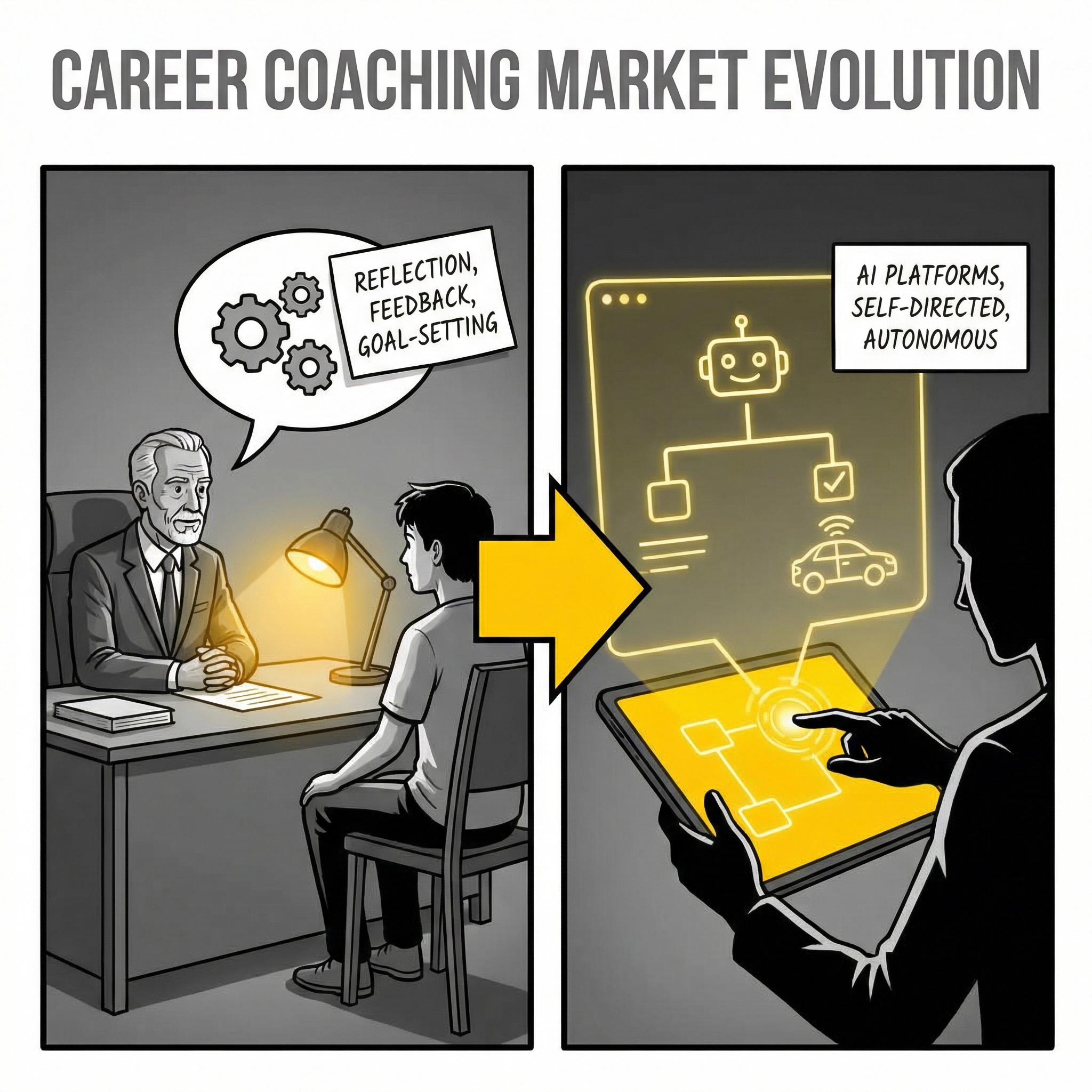
Career coaching is a structured development process that helps a person make better career decisions and follow through - using reflection, feedback, goal-setting, and accountability.
How does Career Coaching Work in Practice?
Usually via an agreed set of goals, followed by a sequence of sessions, and between-session actions (experiments,conversations, applications, skill-building).
The exact blend of “questions vs advice” depends on the coach’s philosophy and what you contract for.
Examples of use-cases for hiring a career coach typically include:
- You’re good at your job but feel stuck; you need a direction, not a promotion.
- You want a pivot (industry/function) but don’t know what’s realistic.
- You’re returning to work and need confidence + a plan.
- You’re performing well but want to accelerate leadership readiness.
- You’re job searching and need strategy, positioning, and practice.
Basically anyone facing a decision, transition, or growth plateau - especially when the cost of 'drifting' is higher than the cost of getting structured advice.
Time & Cost Investment
What is broadly understood, is the high cost – but also potential high reward – of investing in career coaching, for yourself or your team.
Common patterns of time commitment with a human coach, might look lik
- 4–6 sessions for clarity + decision + first actions (often over 4–10 weeks)
- 8–12 sessions for deeper change (identity, confidence, leadership habits) over 3–6 months
- Some exec/leadership engagements run longer (6–12 months), but that’s not required for most career decisions.
Pricing varies wildly by geography, seniority, and coach credentialing.
Useful reference points:
- Global benchmark: ICF’s Global Coaching Study reports an average fee around US$244 per one-hour session (with big regional variation).
- Mass-market career coaching: sources like Indeed cite about US$100–$150 per session on average, while noting variation by location and coach experience.
- Typical range framing: some consumer pricing guides show US$75–$200/hr (and up to $500/hr+) depending on experience and package design.
The benefits of investing in this type of career coaching generally cluster into:
- Decision quality: clearer criteria of needs, less agonising, fewer reactive moves.
- Confidence + momentum: you stop “thinking about it” and start testing your options.
- Execution lift: better conversations, better applications, better interview performance (if included).
- Capability gains: self-awareness, goal discipline, communication confidence, improved leadership behaviours.
Evidence in workplace settings suggests coaching is associated with positive outcomes, though results depend on fit and structure.
A simple ROI lens many leaders relate to:
- If coaching helps you avoid one “wrong-fit” move (or hire), shorten your job search by weeks, enables the negotiation of even a modest comp bump, or reduces months of low motivation, it can pay for itself quickly. (But it’s worth being honest: outcomes aren’t guaranteed - quality and fit matter.)
- And crucially, people inside organisations needto be given the time to both 'be coached' and the support to trial their new capability.
Finding & Hiring a Coach
This is where it gets a bit trickier. Because a traditional coaching engagement is ‘human-to-human’ – so finding the right ‘fit’ – be it approach, personality, relevant industry knowledge or experience, and availability - can be complex.
Before you start searching for a coach, you should first choose your “type”. Research how they position themselves interms of style and approach. Common types of coaching you could receive might include:
- Clarity + direction setting (focus on your identity, your work needs / criteria, exploring options)
- Transition execution (positioning yourself in the market, managing the job application process, preparation for interview)
- Leadership growth (developing leadership behaviours, growing your executive presence, how to improve stakeholder influence)
Then ask coaches how they run that exact methodology and the outcomes they have achieved.
Look for:
- A defined method : not “we’ll see what comes up” every session
- Contracting for clarity: how they set goals, typical session cadence, between-session work, how progress is measured
- Evidence of competence: training, credentials, experience in your level/context
- Fit + trust: interview with them first - you should feel both safe and appropriately challenged
Before hiring a Coach it's alsoimportant to also understand – if you are needing a Coach – or a Mentor. The difference between Coaching and Mentoring is larger than people think, and can often get confused.
A coach typically provides a structured process and accountability, often without needing to be from yourexact domain.
A mentor is more experience-led (“here’s what I did; here’s how this company/industry works; here’s a modelyou can follow”) and typically will offer more advice and examples to follow,than a coach will..
Rule of thumb:
- If you need navigation + thinking + follow-through, choose coaching.
- If you need insider expertise + model affirmation + sponsorship, choose a mentor.
Many people use both (mentor for context, coach for execution).
And it’s important to consider whether you want to appoint or hire an internal coach (inside your company) vs an independent coach.
Internal(inside your company) can be great when:
- the organisation has a mature coaching culture,
- confidentiality is explicit,
- and the coach isn’t also your evaluator/HR business partner.
Independent/external is often better when:
- trust is fragile,
- you want to discuss sensitive topics (manager issues, exit planning),
- or you want unbiased perspective and broader market context.
Whichever style or type of coach you hire – some common pitfalls to watch out for include:
- Vague process, no outcomes, no between-session action
- Over-promising (“I’ll get you a job”)
- One-size-fits-all templates that ignore your context
- A coach who only validates you (comfort) or only pushes you (performance) — you want both
Why platforms like ACTVO® (no 'human-in-the-loop') are a valid alternative
AI-enabled coaching platforms are growing fast, including enterprise tools that blend guidance,l earning recommendations, and internal mobility.
What these platforms are now proving that they can do exceptionally well (especially when there’s no human in the loop) is deliver:
- Always-on momentum: prompts, nudges, and next steps exactly when you need energy (not just when a session is booked).
- Consistency of method: a repeatable process that doesn’t vary by coach quality week-to-week.
- Much lower cost per “touch”: more people get more support, more often.
- Clear method + decision scaffolding: turning confusion into structured options, criteria, and action plans.
- Lower human 'emotional disturbance': with no ‘human’ to interact with, these platforms tend to suit more introverted individuals, or highly neurodiverse – who appreciate a more consistent, structured, lower emotive process.
Where Actvo is distinct –and how we often get asked to compare our platform to traditional coaching – is that we aren’t just “an AI that asks questions.” Nor are we trying to be a human coach, prompting you to find all the answers within yourself.
The model ACTVO follows combines a proven, design-led process with coaching-style reflection,delivered through guided steps, visual structure, and collaborative interaction - so people don’t just talk, they move.
The design principle is "teaching people how to learn", as we've proven that this is a crticial enabler to growth and effective change. On Actvo - people do things, to learn. And by doing, they gain understanding and clarity. ACTVO uses active creativity and learning as a tool for progress.
It’s a hybrid coaching /guiding / solution: where the pace is - reflection + clarity + and options for pathways you can follow, not a blank conversation each time.
Who are these platforms most suited to?
The rise of Ai-enabled career coaching and guidance platforms is widening access to support when it’s most needed. It means that a larger % of the population now have options for career coaching that they can afford, and that are moresuited to their individual needs. These platforms tend to suit:
- People who want self-directed progress (and don’t want to depend on appointment availability)
- People who prefer privacy + control while they explore their options
- People who want agency over advice (to be presented with a structured sequence of options, layered to lead to the right answer – for them).
- Organisations that want to support many employees, not only the “top few”
- Early-to-mid stage decision-makers who need structure and momentum more than deep therapeutic work
This doesn’t mean human-led coaching isn’t still incredibly important. And often is a great complement to these types of platforms.
Undoubtedly, the competitive edge of a humanin career coaching is:
- For high-stakes, high-emotion, highly complex situations (burnout crisis, trauma, severe conflict, major identity transitions)
- When having a qualified and highly trained ‘human’ matters - either a coach, therapist, or trusted advisor depending on the need.
How Career Coaching is Changing (future predictions)
Like every industry category, career coaching is evolving – to meet the increasingly diverse needs of the market, and to embrace technology. A few notableshifts are already visible:
1) Coaching moves “into the flow of work”
Instead of being a calendared event, coaching becomes embedded in tools people already use: internal talent marketplaces, learning platforms, workplace chat, and copilots.
2) Hybrid Human + AI becomes the default
Many platforms are explicitly positioning AI for day-to-day moments and humans for deeper, nuanced development (not either/or). The combination of the platform for personal ‘development’of ideas – with a manager or coach to guide deployment, is emerging as the default best practice answer.
3) More emphasis on outcomes, not just hours
People now expect tighter measurement from coaching – whatever the form: eg skills gained, mobility movemade more possible, engagement lifts, retention risk reduced, goal attainment improving, performance lifts - especially in B2B contexts where buyers demandproof.
This also raises ethical questions about privacy and surveillance, so “responsible coaching tech solutions” will matter more.
This is something we care deeply about at ACTVO.)
4) Category split: “career navigation” vs“career execution”
The market is likely in the future to separate into
- scalable digital guidance for clarity + continuous development, and
- premium human coaching for leadership identity, complex transitions, and emotional load.
They are very different objectives – and outcomes. And therefore the tools used (if digital) need to be explicitly examined for capability ineach area.
5) Trust and ethics as a differentiator
As AI coaching grows, people will care more about:
- data sovereignty, privacy & boundaries,
- transparency (what the system does/doesn’t know, what is does with your data),
- and whether the method is genuinely evidence-informed (vs. generic chat).
These are all principles we care deeply about at ACTVO.
. . . . . . . . . . . .About ACTVO®
ACTVO® brings you both a proven Career Planning System & an Ai-enabled toolbox. Before building ACTVO® - the self-directed, all-in-one career & skills growth platform - our Founder alone spent more than 16,000 hours using data and behaviouralscience to mentor and guide professionals across industries and geographies, innew and adaptive career strategies. That work revealed a consistent problem:capable people and growing organisations struggle to turn ambition intostructured, sustainable career development.
Understanding this challenge, and how easily careers drift without clear direction and systems, is in our DNA.
That experience is now encoded in ACTVO®. Our platform brings personal career clarity, visible growth planning, learning & skill development and ongoing support into one system - to help individuals and teams move from loose intention to consistent planned progress. Improving retention, productivity and lowering of costs.
ACTVO® is particularly effective for professionals andorganisations that are ambitious but time-poor, providing the structure and visibility needed to make developing people’s performance and progression inside an organisation, simpler.
Keen to find out more? Start a free trial.
.avif)