Why Most Careers Fail Before People Quit – And What Leaders Must Do Differently in 2026
.png)
About 10 years ago I hit the eject button on my corporate career. After decades of making my career my life and holding some globally significant roles, I had finally hit a wall - and needed a break, and a massive change.
To what though? I can honestly say - I had no plan, not much saved for the ‘rainy day’ that had unexpectedly arrived, and a headful of emotion. Career planning is hard, and I found that out the hard way.
And importantly - I realised this wasn’t just my story. It turned out to be an early signal of a structural failure in how we design careers. Keep reading.
In making that one choice to ‘rage quit’ my job, I discovered that adapting your career under pressure is more than tough - it is a high-risk decision made under conditions of extreme uncertainty. When one of your most valuable assets has been built over decades, walking away without a clear set of options is not just emotionally charged - it is structurally dangerous.
But you know what’s worse for most people? Remaining in a role where the personal risk of speaking honestly outweighs the perceived upside of staying. Where the power dynamics of the employment relationship make transparent career conversations feel unsafe. That was me.
And hence, my new story began
.jpg)
Through my work since founding START Now, I’ve worked with thousands of people globally on their own journey of career adaptation - many incredible people who trusted me to help them reconstruct a career when their sense of direction, confidence, or momentum had fractured.
I’ve done multi-day workshops, sold masterclasses, hosted events - and sometimes simply had quiet coaching conversations over coffee. I’ve worked inside organisations with leaders and teams to redesign career pathways, train managers on credible career conversations, and build structured career-planning methodologies for HR teams.
And my favourite work? Teaching this methodology inside universities to highly diverse, early-career starters. It’s been a wondrous journey.
In the beginning, I never really saw this work as my ‘real job’. It was something I did alongside consulting work - designing innovation strategies and service systems using human-centred design methods I’d learned at Stanford.
Being labelled a ‘career coach’ was never a title I adopted - not because I rejected the work, but because I rejected the industry framing. Despite returning to Stanford six years ago to become one of the first people globally accredited in the Design Your Life coaching methodology, the label itself felt narrow, reductive, and disconnected from the strategic, systems-level work I was used to - and actually doing.
Career coaching, as it has been traditionally positioned, felt like it was solving symptoms - not the structural conditions that create career distress in the first place.
Lately, I’ve taken a very different view. And here’s why.
As the world has become more disrupted - economically, environmentally, and technologically - people’s expectations of work have fundamentally shifted. What it means to feel fulfilled, successful, and motivated has changed faster than most organisational systems have been able to adapt.
We now know that the majority of people are disengaged at work. But more telling than disengagement itself is option scarcity - the widespread inability for people to visualise credible, low-risk alternatives to their current situation. So they stay. Not because they are committed - but because moving feels simply, too dangerous.
This creates a compounding negative dynamic: Fear, complacency and learned helplessness is both keeping people in jobs they no longer fit, while organisations experience lowering productivity, creativity, innovation and contribution from their employee base.
A lose–lose equilibrium.
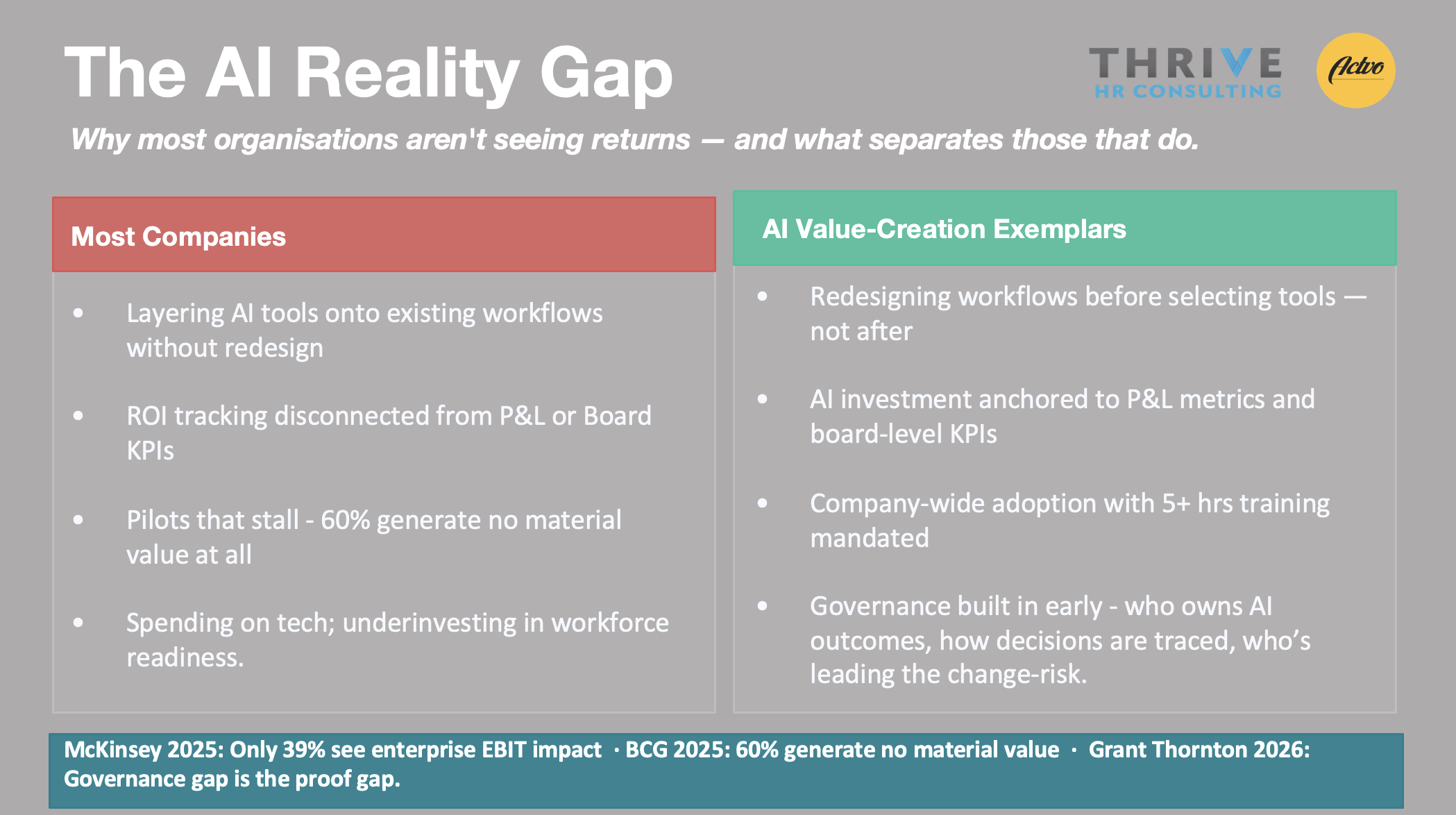
At the same time, the workforce is getting younger - and definitions of purpose, reward, and success have been fundamentally reframed. According to the World Economic Forum, companies are now being required to bridge accelerating skills gaps, absorb the cost of on-the-job reskilling, adapt to AI, and maintain cultures that support performance across increasingly diverse and global teams.
The role of a people manager, has quietly become one of the most overloaded and under-supported positions in most modern organisations.
This result? A convergence of human fear and option paralysis, manager overload, and skills volatility. This dynamic has undoubtedly now exposed the limits of traditional career planning systems.
Linear ladders, annual performance cycles, and ad-hoc career conversations cannot absorb this level of complexity. They are quite simply, not working any more.
And this is where the causal shift at work, became undeniable for me and my work.
If traditional systems cannot scale clarity, safety, and adaptability - then a new system is required.
What began for me as a “side hustle” now revealed itself as a structural problem space with enough depth, urgency, and consequence to commit to for another decade.
And so I pivoted again - this time to create Actvo.
Actvo was born from over ten years of behavioural data, science, lived insight, and proven methods for helping people first adapt themselves - so they can then align to work that genuinely fits them. These people know what good fit looks like - they just needed the tools to get there. They don’t need a coach, and they don’t need managers to do it for them. They want to do it for themselves.
Partnering with AI, my purpose is now to scale this capability - not as a product feature, but as a new operating system for talent growth both inside organisations, and for those leaving.
Because we all need to keep reinventing how we activate, develop, and retain human capability.
Leadership Insights for Creating Growth
Here are my Leading Insights for Leaders & People Managers heading into 2026, for how to start immediately re-engaging your employees, and avoid the continuous unnecessary burn and churn.
Think of these as Leading Indicators, not soft advice. These are observable, repeatable patterns that I have tracked and codified across industries and leadership levels. They are truths - not tips.
They come from working over the past 8 years with a diverse range of people all heading for the door - in high powered, successful, or what was once their ‘dream job’ and who suddenly became desperate to leave. Companies - just like yours.
They were not leaving because they lacked ambition. They were leaving because the personal risk of honest disclosure about their unhappiness - had become too high. And the organisational pathways for reinvention were too vague, or simply unavailable. Many experienced intense anxiety driven not by workload alone, but by the absence of safe, clear and supported options for their future.
Admitting uncertainty - or even fear - felt professionally dangerous. They lacked Agency + Pathways - the two main ingredients for Hope. So they left.
If you want to keep your high-performers in 2026 - here are a few things to watch out for:
1. Notice the Tipping Point
he earliest signal is rarely dramatic. It is subtle behavioural drift. Watch closely. Keep an eye on your ‘assets’. And you will see it coming - Reduced participation, emotional volatility, or disengagement from previously energising work.
These are not performance issues - they are indicators of people being misalignment under pressure.
This is the first crack – and the longer you leave it, the deeper the impact for you (on productivity) and them (on mental & physical wellbeing). Act fast. Ask Questions. Be courageous, find out what’s going on, before it’s too late.
2. Create Value Exchange
One thing I learned from 10 years working in the stock-market, is that the price has to be right when you are in the business of ‘value exchange’. And that’s what being an employer is.
You have to trade what you offer, with what they offer. If you can’t meet the needs of your employees – and it starts from actually understanding their needs, they will sell out.
Start listening – what does ‘reward’ mean for them? What does ‘having impact’ mean for them? And what does ‘meaningful work’ mean for them? And – most importantly – what is it that they are able to truly offer that’s of value to you?
Most people I start working with, can’t tell me. CEOs, Marketing Directors, Analysts, Graduates. It’s one of the hardest things for people to articulate - I put it down to fear. They worry that they will be ‘over-selling’ themselves, or somehow appearing ‘too confident’ - if they in fact, just tell people, what they are actually really good at. It’s also hard thought, as there is a lot of data, that makes up, a good answer. I know, because I’ve codified that into a process.
And so if they can’t tell me, they can’t tell you. When coached though, it is evident they have so much more to offer, than they are able to articulate.
People need some help with this. They may lack confidence to speak ‘beyond their boundaries’. Or they may just lack confidence, period.
If you can figure out what the true value on offer is from every single one of your employees - you may have a more valuable transaction in play than you realise. You are probably sitting on a gold mine of latent talent, that may be getting ready to walk.
But whatever you do, don’t offer an under-valued contract – that’s a sure way to lose the deal.
3. Navigating Craftsmanship & Leadership
This is an interesting one. I help so many people figure out where they are on the trajectory between being a ‘craftsperson’ and a ‘leader’.
You see with some leaders in organisations, their unconscious bias kicks in and they want everyone to be ‘leaders’, just like them. But here’s the reality - , not everyone wants this. Not everyone wants to lead, or manage people - or things.
Some people, just want to learn to be the best, at their craft. Or maybe more than one craft. They want to learn skills that make them feel purposeful. They want to solve problems. They want to make stuff that works and contributes to the world.
Being a leader? That’s for someone else.
So figure out who in your team is happy just staying right where they are, but getting really really good at what they do. Like the best in the world.
If you can navigate through your organisation and get your team of ‘craftspeople’ (specialists) and ‘leaders’ (generalists) onto the right side, and support them to grow differently, you will have created a healthy, highly productive and sustainable organisation.
4. Create Purpose + Proposition Fit
We are all – employers and employees – trying to simultaneously solve problems, have impact, and gain payback.
The alignment comes, when you can match the Purpose that drives an employee, with the Proposition of your organisation.
If you can offer staff problems to solve and an equitable payback that brings them purpose AND that aligns with the proposition and challenges your organisation is facing, you will have what I call ‘human/business fit’.
It’s a similar concept to what Founders chase when trying to find ‘product/market fit’ – it takes time. You have to experiment with this, and figure it out not for – but with – each person (each asset) in your organisation. And once you’ve codified who are the people that fit - find more, and for God’s sake keen them.
Don’t just hire people for their skills – hire people for their intention. For their purpose. Because that’s, what creates businesses that last.
5. The Dance of ‘Love vs Need’
We all have reasons why we go to work, and these start off – like a hierarchy – normally with getting the basic essential needs met.
Like getting paid, and feeling ‘competent’ - valued and a sense of achievement.
But very quickly, we want more. Research tells us that most people’s learning curves are about 2-3 years. Unboutedly, everyone would love to ‘lover what they do’. But very very few achieve it. Why?
We need our emotional needs met. . And this includes feelings. Scary, but real. All humans – and everyone I have met and supported to change careers – have left organisations because either their emotions – or their creativity – (or worse both) were suppressed.
What they love doing, and what brings them emotional joy, is absent.
It’s a basic idea – and one that we are all familiar with in our other core relationship in our lives – our partner and family and communities. If we just provide a home and food, it’s not enough. So too with work.
Figure out what your employees love, what brings them joy, what lights them up, and then your relationship will transcend to the top of the needs hierarchy triangle - love, belonging, connection, and psychological safety. AKA - loyalty. Growth, Productivity, Innovation.
When Needs + Love are met by an employer – and it is a dance – because it’s constantly changing – excitement returns to the relationship and possibilities are endless.
In Closing
These are not easy things to get right. Employees + Employers need many more and many new tools to help with this work. We are underestimating the scale of the problem grossly, and focussing on all the wrong things.
When actually, it’s well documented. $8.8 trillion globally. About 10% of GDP. So for your company - figure out the 10% of revenue number - that’s what it’s probably costing you.
Engagement is hard to achieve, but I believe can start simply.
From purely from one action - Dialogue. Listening with intention. And listening for insight.
My work at Actvo is just getting started. I’m excited to be able to use all that I’ve done over the past 10 years, now partnering with highly-trained AI, to have more scale.
To support people managers and leaders with the two ‘jobs’ that are the hardest - lifting people’s performance and progressing them.
What worked before, won’t work in the future. All employers need to work harder at what they offer and how they support people, and all employees need to get smarter – about who they are, what value they can create, and communicating what they want.
Because just like you as a leader, this is hard for many people to do on their own. You have to offer them a little bit of help. And you have to put the work in.
Actvo gives everybody the opportunity – privately and affordably – to figure out what work brings them joy, and how they are going to transition into it. It creates the dialogue and plan for continued success in your organisation - you just need to sponsor it, support them, and create the pathways.
And if you’re a really smart leader, you won’t care whether that’s within your organisation – or another. Because as long as people are engaged, fulfilled and productive, we all win.
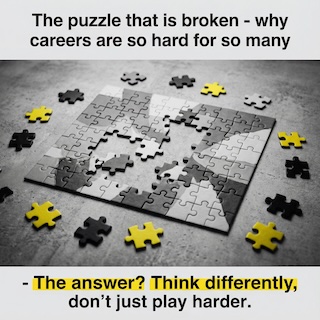
There is a great saying I heard once. “Life is like a puzzle – never waste time trying to place the pieces where they don’t fit”.
.avif)